Parents Guide: What to Expect from 1-on-1 Online English Tutoring
If you're considering 1-on-1 online English tutoring for your child, you probably have questions. What actually happens in a lesson? How do you find the right tutor? Will your child enjoy it — or sit there frozen on screen? These are all reasonable things to wonder about, especially if this is your first experience with personalised online learning.
This guide covers everything parents need to know, from setting up your home for the first lesson to tracking your child's progress over time.
How Online Tutoring Works
Unlike a classroom where a teacher divides attention between twenty students, 1-on-1 online tutoring means every minute of every lesson is focused entirely on your child. The tutor adapts the lesson in real time — slowing down when something is tricky, accelerating when your child is flying.
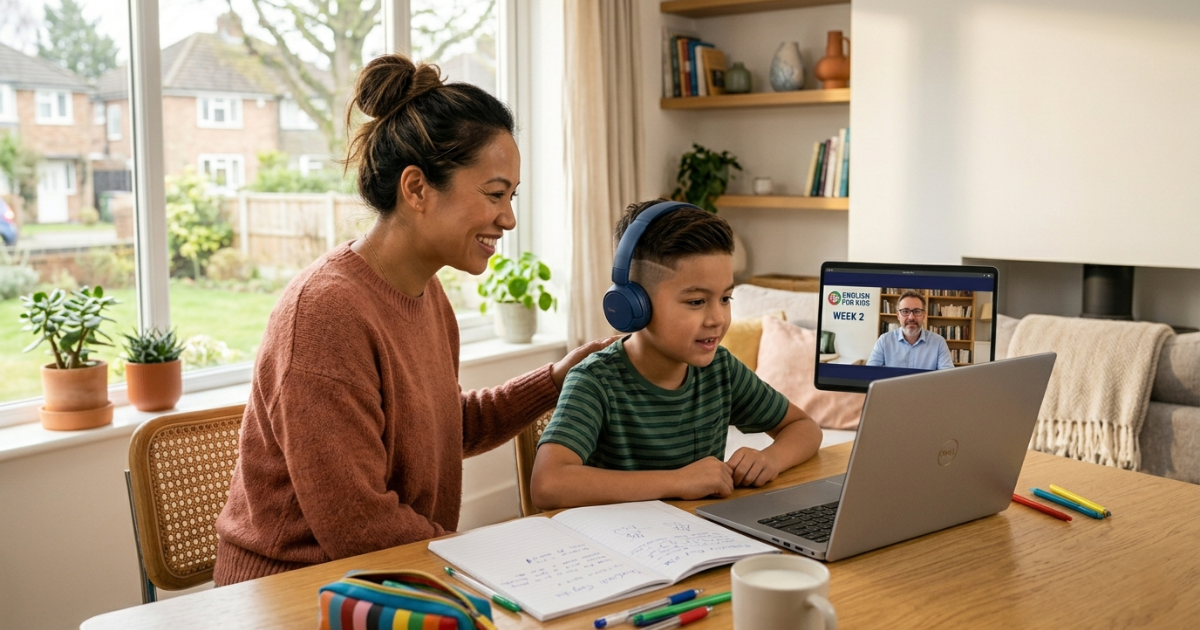
Sessions typically take place on a video platform (ExpatTeaching uses ClassIn, which is designed specifically for education). The tutor and student can see each other, share digital materials, write on a virtual whiteboard, and even play vocabulary games or watch short clips — all within the lesson environment.
Most lessons for primary-age children run 25–30 minutes. For older students and teenagers, 45–55 minutes is common. The rhythm varies depending on age and goal, but you'll typically see:
- A warm-up activity — a quick game, a question, or a review of last session
- Core teaching — new vocabulary, grammar, reading, or speaking practice
- Production — your child using the new language in context (role play, story-telling, answering questions)
- A wrap-up — recap and preview of next session
Preparing Your Child for Their First Lesson
The first lesson can feel a little awkward — for children and parents. Here's how to set your child up for success.
Setting Up the Learning Space
Choose a quiet spot in the house where your child can focus. Ideally:
- Good lighting — your child's face should be clearly visible on camera. Natural light from a window works well; avoid sitting with bright light behind them.
- Minimal distractions — turn off the TV, ask siblings to give space, close the door if possible.
- A comfortable chair and table — your child should be able to sit comfortably at eye level with the screen for 25–30 minutes.
- Stable internet connection — if video keeps cutting out, try moving closer to the router or using a wired connection.
What Your Child Will Need
- A laptop, tablet, or desktop computer with a working camera and microphone
- Headphones (optional but helpful — reduces echo and helps your child focus)
- A notebook and pencil for some tutors' sessions
- The ClassIn or agreed platform installed and tested before the first lesson
Tip: Do a test login 15 minutes before the first lesson. Technical hiccups are common and easy to fix — you just don't want them happening when the tutor is waiting.
What to Tell Your Child
Many children feel nervous before their first lesson. Reassure them:
- "The teacher is kind and patient — their whole job is to help you."
- "It's okay to make mistakes. That's how we learn."
- "You can ask the teacher to repeat anything you don't understand."
For younger children especially, framing the lesson as an adventure rather than a test makes a big difference.
What Happens During a Lesson?
Most parents are surprised by how engaging 1-on-1 online lessons are. A good tutor will keep your child active throughout — speaking, responding, problem-solving — rather than passively listening.
At ExpatTeaching, our tutors are trained to:
- Use clear, simple language appropriate for your child's level
- Respond with warmth — children learn better when they feel safe making mistakes
- Keep activities varied — switching between games, conversation, reading, and writing to maintain attention
- Track and build vocabulary systematically across sessions
- Communicate with parents via after-lesson notes or summaries
If your child is shy at first, don't worry. Most children become comfortable with their tutor within two or three sessions.
How to Choose the Right Tutor
This is perhaps the most important decision in the whole process. The relationship between tutor and child matters far more than a certificate or CV.
Qualifications to Look For
Look for tutors with:
- A TEFL, CELTA, or equivalent qualification (120+ hours)
- Experience teaching children — particularly at your child's age group
- Native-speaker or near-native English proficiency
- Positive reviews from other parents
That said, qualifications alone don't make a great tutor. Enthusiasm, warmth, and the ability to connect with young learners matter just as much.
Trial Lessons and Compatibility
Most reputable platforms — including ExpatTeaching — offer trial lessons. Use this trial to assess:
- Does your child seem engaged and comfortable?
- Does the tutor explain things clearly and check for understanding?
- Does the pacing feel right — not too fast, not too slow?
- Do you feel confident the tutor genuinely enjoys teaching children?
If the first tutor isn't a great fit, it's completely normal to try another. The right match makes an enormous difference to long-term progress.
Tracking Your Child's Progress
Progress in language learning is rarely linear. Your child might have a great few weeks, then seem to plateau — before suddenly making a leap forward. This is completely normal.

Here's how to monitor progress meaningfully:
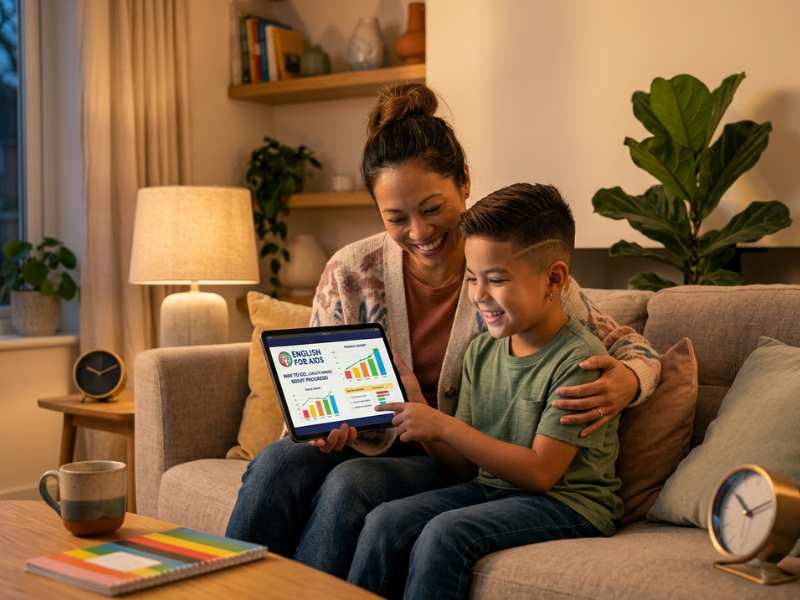
In the first month, focus on engagement and confidence. Is your child looking forward to lessons? Are they more willing to speak? These early signs matter more than test scores.
After 1–2 months, you should start to see vocabulary growth. Pay attention to whether your child is using English words unprompted — in conversation, while watching cartoons, or in play.
After 3–6 months, measurable improvement in reading comprehension, speaking fluency, or writing (depending on your focus) should be visible.
Keep a simple progress journal — jot down things your child says or does that show English development. It's encouraging for both of you, and useful to share with the tutor.
Communication with the Tutor
Don't be afraid to communicate with the tutor between sessions. Good tutors welcome parent input. Let them know:
- Topics your child is interested in (animals, football, space, cooking)
- Areas you'd like more focus on (reading, speaking, exam preparation)
- How your child is feeling — if they've had a hard week, the tutor can adjust accordingly
Common Questions Parents Ask
How often should my child have lessons? Two to three sessions per week is ideal for steady progress. Once a week will still produce results but more slowly. Consistency matters more than frequency — a reliable weekly lesson beats an intense burst followed by a long break.
What age can children start? Most children do well from around age 5–6, though some 4-year-olds thrive in very short, playful sessions. The most important factor is whether your child can focus for 20–25 minutes — and whether they're curious rather than anxious about the screen.
My child is very shy. Will online tutoring work? Yes, often better than classroom learning. Many shy children feel less pressure in a 1-on-1 setting with no peers watching. A patient tutor who doesn't push can bring out a shy child's confidence over time.
Do parents need to sit in on lessons? For younger children (under 7), being nearby is helpful — you can step in if there are tech issues. For older children, it's generally better to give them space. Being observed by a parent can make some children more self-conscious.
Making the Most of Every Lesson
A few habits will make your investment in tutoring go further:
- Be consistent — try to keep the same lesson day and time each week
- Review the lesson notes — most tutors provide a post-session summary; look through it with your child
- Encourage English outside lessons — even 10 minutes of an English cartoon a day reinforces what was taught
- Celebrate small wins — every new word, every sentence spoken with confidence is worth acknowledging
Ready to give your child an English advantage? ExpatTeaching connects families with expert, qualified tutors who specialise in engaging young learners. Book a trial lesson and see the difference personalised attention makes.
👉 Book a free trial: expatteaching.com